
The Coaching Habit
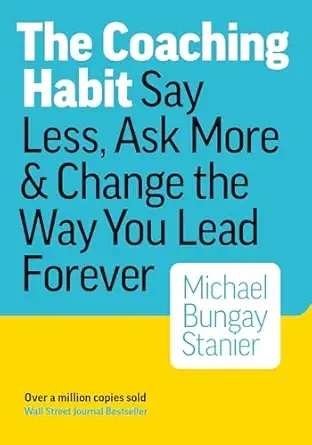
Michael Bungay Stanier
Seven questions that turn 1-on-1s back into actual conversations — by replacing the manager’s solving reflex with curiosity.
Stop being the answer machine
If your 1-on-1s have quietly turned into status meetings — your report gives an update, you offer advice, repeat — the problem isn’t the agenda, it’s the reflex. Managers, especially those promoted from senior IC roles, are wired to solve. Stanier’s argument is that the job isn’t to have the answer; it’s to ask the questions that help the other person find theirs. The book’s whole toolkit is seven questions, used as reflexes rather than a script.
1) The Kickstart Question — “What’s on your mind?” It opens a conversation in a way that’s focused but not constraining, getting straight to what actually matters to the other person.
2) The AWE Question — “And what else?” The first answer is rarely the real one. This question quietly insists there’s more, without putting words in their mouth.
3) The Focus Question — “What’s the real challenge here for you?” Resists the urge to attack the first problem mentioned — which is rarely the real one — and the “for you” anchors it to their challenge, not yours.
4) The Foundation Question — “What do you want?” Surprisingly hard to answer in the moment. It forces clarity between what someone is venting about and what they actually want to happen next.
5) The Lazy Question — “How can I help?” Stops you from charging in with a solution before knowing what’s actually being asked, and forces the other person to make a clear request.
6) The Strategic Question — “If you’re saying yes to this, what are you saying no to?” Every commitment has a hidden cost. This makes the tradeoff visible before it becomes a regret.
7) The Learning Question — “What was most useful for you?” Closes the loop by making them extract the value, instead of you summarizing what you think they should have taken away.
Who should read it: managers who feel their 1-on-1s have become status meetings, tech leads stepping into people-leadership, and anyone promoted from a senior IC role who can’t stop solving problems out loud.